How to choose
Choosing outdoor furniture that survives your weather
Teak, aluminum, powder-coated steel or resin: what each material costs you in upkeep hours per year, and which failure actually ends a patio set early.
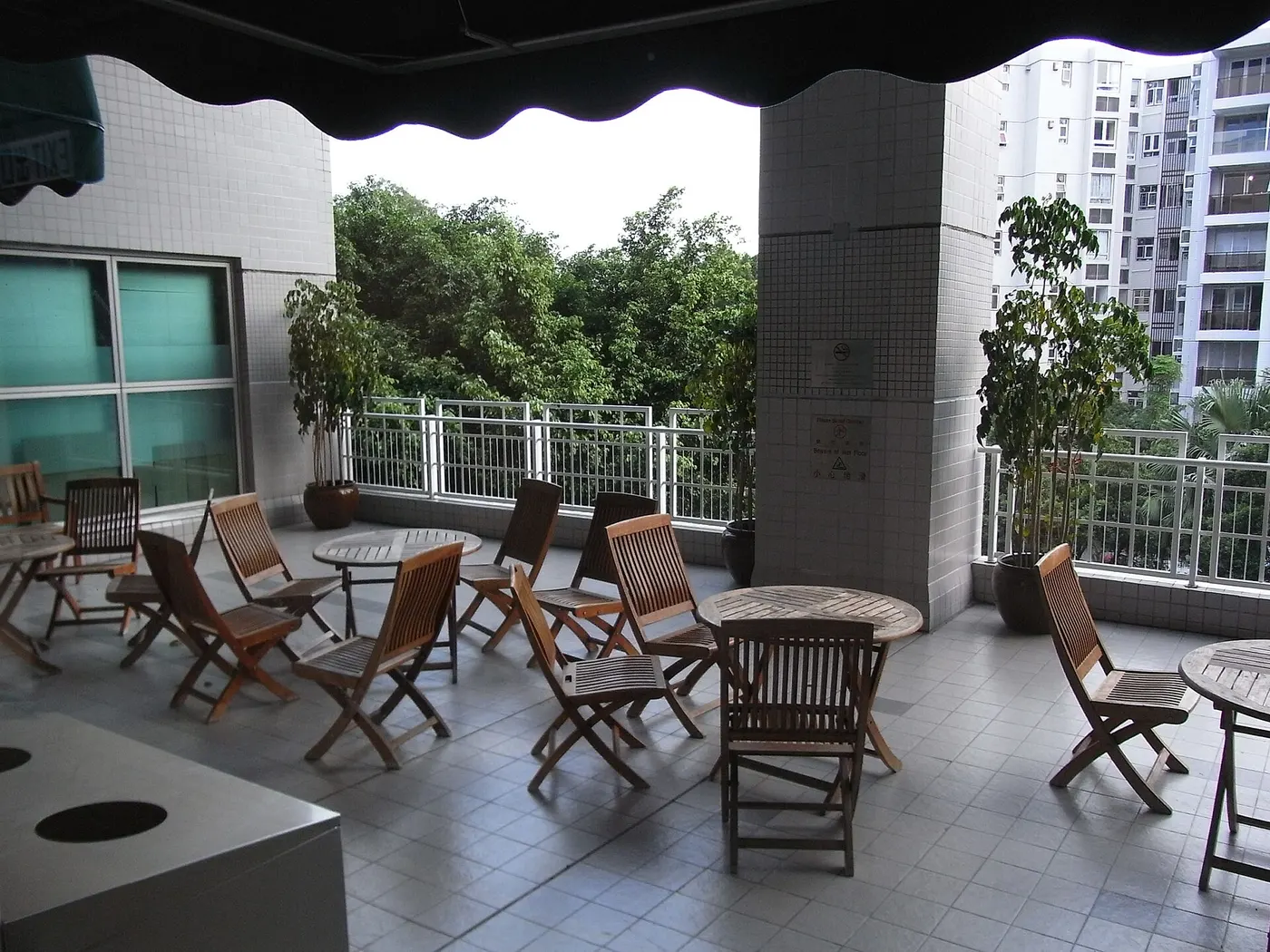
Outdoor furniture does not wear out evenly. It fails at joints, at fasteners and at fabric, and which of those goes first is decided almost entirely by how much sun and standing water the set takes, not by what the showroom card said about the frame.
This guide takes the four material families in turn, says what each one actually fails at, and puts an upkeep budget in hours a year against each. Prices below are example figures, labelled as such in the same sentence, because this site runs no price feed and quotes no seller.
Advertisement
Start with the exposure, then pick the material
The Environmental Protection Agency publishes the UV Index on a scale where 1 to 2 is low and needs no protection, 3 to 7 is moderate to high and needs protection, and 8 and above is very high to extreme and needs extra protection. The same scale is a reasonable proxy for what your furniture is taking, because the ultraviolet that burns skin is what breaks down cushion fabric, resin wicker and the resin binders in powder coat.
That gives you a usable first question: how many hours of direct midday sun does the spot get between May and September, and is there any roof over it. A terrace that gets four hours of afternoon sun is a different problem from a south-facing deck that gets nine.
Water is the second variable and it matters more than rainfall totals suggest. Standing water in a seat pan, in a hollow leg or under a flat foot is what starts rot in wood and corrosion at steel welds. A set that drains, raised on feet rather than sitting flat on a slab, outlasts a set that holds a puddle, in every material on this list.
| Material | Under a roof or awning | Partly shaded | Full sun and open to rain |
|---|---|---|---|
| Teak and other dense hardwood | about 1 hour | about 2 hours | about 3 to 4 hours |
| Powder-coated aluminum | under 1 hour | about 1 hour | about 2 hours |
| Powder-coated or galvanised steel | about 1 hour | about 2 hours | about 3 hours |
| Resin wicker over an aluminum frame | about 1 hour | about 2 hours | about 3 hours |
Hours cover washing, re-oiling or touching up coating, and checking and tightening fasteners. They are planning assumptions for budgeting your own time, not test results. Cushions are counted separately because they come indoors.
What each material actually fails at
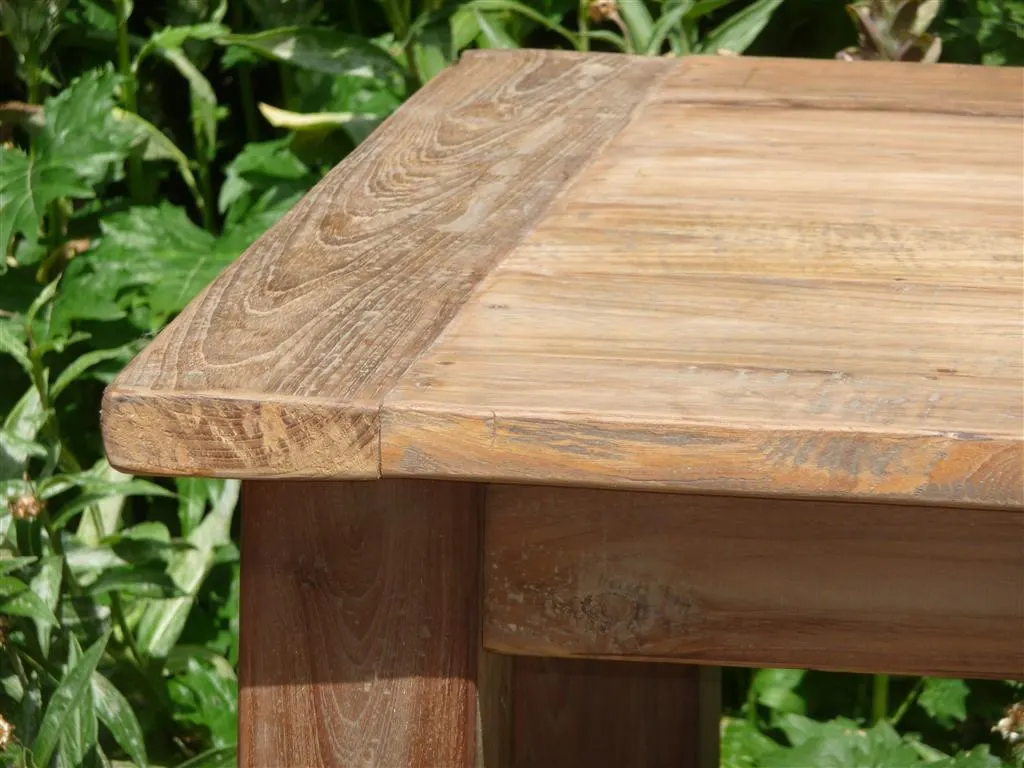
Dense hardwood fails at the joint and at the fastener, not at the surface. Grey weathering is cosmetic; the set is finished when a mortise opens up because the wood moved through enough wet and dry cycles, or when a steel bolt rusts inside a leg and splits it. Stainless or brass fasteners are the thing to look for, and they are visible before you buy.
Powder-coated aluminum fails at the coating, usually where a welded joint was not prepared properly or where a chair leg scrapes a slab. Aluminum underneath does not rust, so a chip is a cosmetic problem until water gets under the coating and lifts it in a sheet. Touch-up paint is a five-minute job and skipping it for two seasons is what turns it into a refinish.
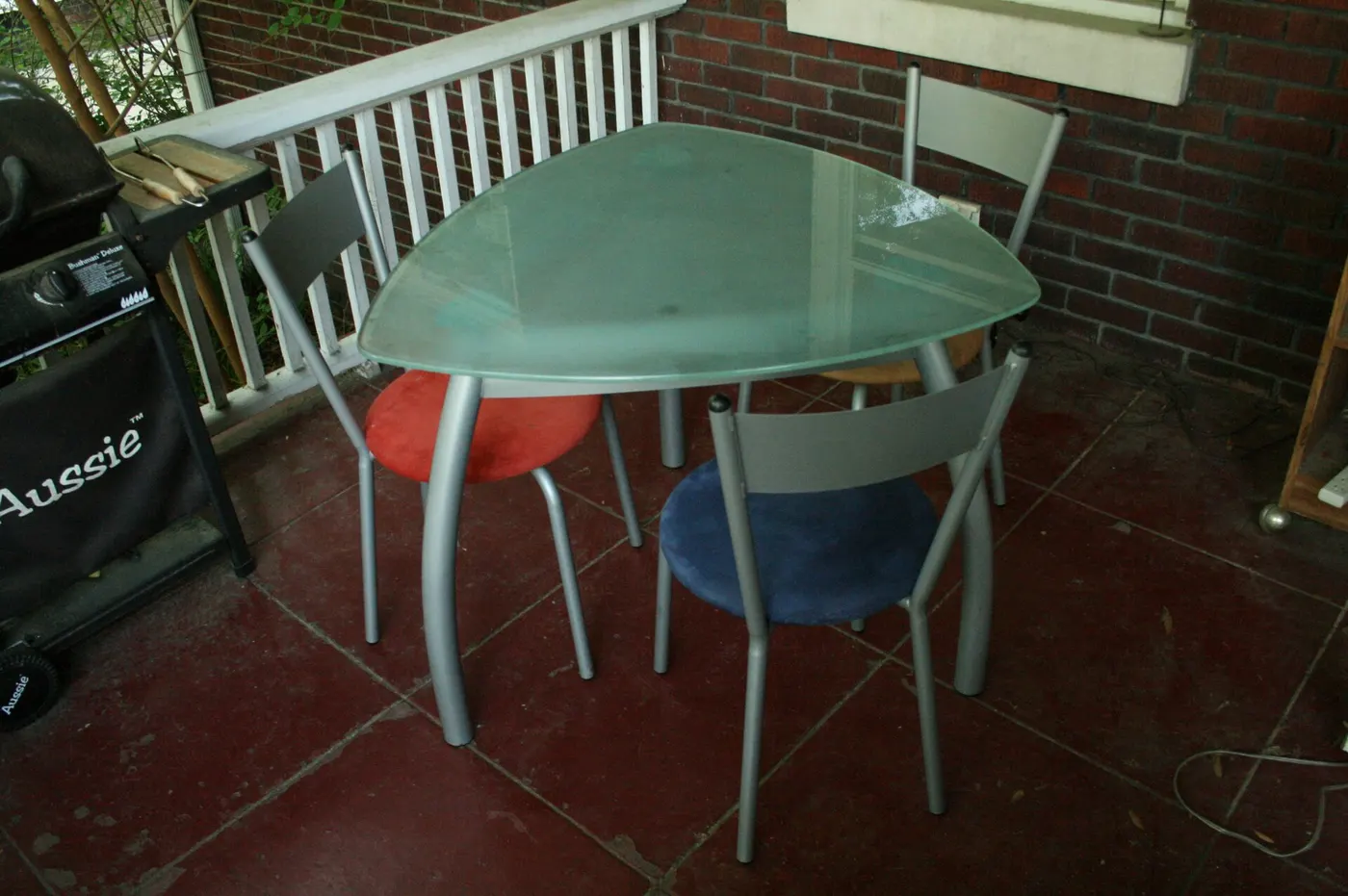
Steel fails at the weld and at the foot. Galvanising buys you years and powder coat on top buys more, but a steel frame standing in a puddle on a flat foot will go through both from underneath. Resin wicker fails at ultraviolet exposure: the strands go brittle, then crack at the weave where they bend tightest, which is the front seat edge on every chair ever made.
| Material | What fails first | What delays it | Repairable by an owner |
|---|---|---|---|
| Dense hardwood | Opened joints and corroded internal bolts | Stainless fasteners, feet that keep it off wet ground | Yes, with a socket set and new bolts |
| Powder-coated aluminum | Coating chips at welds and feet | Touch-up paint within the season | Yes |
| Powder-coated steel | Corrosion at welds and under flat feet | Galvanising under the coat, plastic foot caps | Partly, once a weld is through |
| Resin wicker | Brittle strands cracking at the front seat edge | Shade, or a cover between uses | Rarely, unless the maker sells strand |
Observations about where each material gives way are drawn from how the materials behave, not from any test programme run by this site.
If you are buying wood, know what the treatment is
Untreated dense hardwood and pressure-treated softwood are two different purchases. The Environmental Protection Agency registers a specific set of chemicals for pressure treatment, including alkaline copper quaternary, borates, copper azole, copper naphthenate, copper-HDO and polymeric betaine, and it keeps three heavier preservatives for commercial and industrial use only.
The best-known of those three is the chromated arsenical family. The agency records that effective December 31, 2003, manufacturers voluntarily cancelled virtually all residential uses of chromated copper arsenate, so wood treated with it is no longer used in most residential settings including decks and children's play sets. Creosote and pentachlorophenol have no registered residential uses at all.
The practical consequence for a buyer is simple. A new pressure-treated softwood table bought in the United States is treated with one of the copper-based or borate systems rather than the old arsenical one, and a reclaimed deck board of uncertain age is not something to make a dining surface out of. For a table people eat off, dense untreated hardwood with stainless fasteners avoids the question entirely.
- Chemicals the EPA registers for pressure treatment of wood: ACQ, borates, copper azole, copper naphthenate, copper-HDO and polymeric betaine
- Chromated arsenicals: residential uses voluntarily cancelled effective December 31, 2003
- Creosote and pentachlorophenol: no registered residential uses
- A dining surface is the one piece worth buying in untreated dense hardwood rather than treated softwood
- Check the fastener heads before the finish: stainless or brass outlasts plated steel by years
Cushions are a consumable, and they are the fast-moving cost
A frame is a ten-year purchase and a cushion is a three-year one, which is why quoting a set price without a cushion plan understates the cost badly. At an example $240 for a four-seat cushion set replaced every 3 years, that is $80 a year, and over 12 years it is $960, which can exceed what the frames cost.
Solution-dyed acrylic holds colour through the fibre rather than on it, which is why it fades slowly under the ultraviolet the EPA scale describes; printed polyester fades fast in the same spot. The gap is largest exactly where it matters: a set in full sun under an index of 8 or above.
The cheapest thing you can do about cushions is bring them in. A deck box, a bench with a lid, or the five minutes it takes to carry them inside, is worth more than any fabric upgrade. A cushion that spends its nights dry lasts roughly twice as long as one that does not, and that is a storage decision rather than a purchase.
A decision order that wastes least money
Work in this sequence: exposure, then storage, then material, then price. Deciding price first is what produces a resin set in full sun that is brittle in year four, and a teak set on a covered terrace that never needed to be teak.
If you have a roof or an awning over the spot, almost everything works and you should buy on comfort and how it looks. If the spot is open and faces south, the choice narrows to powder-coated aluminum and dense hardwood, and the money is better spent on the frame than on the fabric.
If you have nowhere to store cushions, buy chairs with slatted seats that need no cushion to be usable, and treat any cushion you do buy as a three-year consumable from the start. Our cost-per-year guide runs that arithmetic for three example price bands, and the room-fit calculator on this site checks the set will fit the space before you commit to any of it.
- Count the hours of direct midday sun the spot takes between May and September
- Decide where cushions will sleep before you choose a fabric
- Pick the material from the failure table rather than from the showroom finish
- Check fasteners and feet: stainless heads and plastic foot caps are worth more than a finish upgrade
- Budget cushions separately as a 3-year consumable
- Run the footprint through the room-fit calculator before paying
Before you buy
- Time the direct midday sun the spot receives on one clear day in each of two seasons
- Decide now where cushions will be stored overnight and in winter
- Turn a chair over in the shop and look at the fastener heads and the feet
- Confirm that the frame is raised on feet rather than sitting flat on the slab
- Ask whether touch-up paint, strand or replacement slats are sold for the model
- Price a replacement cushion set and divide it by 3 years to get the annual consumable figure
- Put the set footprint through the room-fit calculator before you pay
Questions readers ask
- Does teak have to be oiled?
- No. Oiling is a colour decision rather than a protection one, and unoiled teak weathers to grey without losing strength. What does need doing is washing off the organic film that grows on a damp horizontal surface, and checking the bolts once a year. Budget about 3 to 4 hours a year in full sun, less than half that under cover.
- Is aluminum always better than steel outdoors?
- For corrosion, yes, because aluminum does not rust when the coating chips. For stability, no: steel is heavier, and a heavy chair stays put in wind that moves an aluminum one across a deck. On an exposed roof terrace the weight is the reason to accept the extra 1 hour a year of upkeep steel needs.
- How long do resin wicker sets last in full sun?
- The failure to watch is brittleness at the front seat edge where the weave bends tightest, and ultraviolet exposure drives it. On the EPA scale, a spot that regularly reads 8 or above is taking the extreme end of that exposure, which is why resin sets belong under an awning, under a tree, or under a cover between uses.
- Should I worry about old pressure-treated wood?
- For anything reclaimed from before 2004, yes, enough to not make a dining surface from it. The EPA records that residential uses of chromated arsenicals were voluntarily cancelled effective December 31, 2003. New pressure-treated stock sold for residential use is treated with copper-based or borate systems instead.
- What is the single best upgrade on a budget set?
- Plastic foot caps and stainless fasteners, in that order, and together they usually cost under $25 as an example figure. Flat feet standing in water and plated steel bolts rusting inside a leg are the two failures that end cheap sets, and both are fixable on the day the set arrives.
Sources
Some links on this site can earn us a commission. That does not change which product a guide recommends, and it adds nothing to your price.